Posts

How to become an Official

Image
Most swim clubs rely heavily on their parent volunteers to host swim meets & many clubs enforce or mandate that the parents volunteer a set number of hours per year, since without the help of such volunteers, swim clubs will not be able to operate.  Our club would send an email that the sign-up for volunteers will be posted at a certain time – but by the time I clicked on the sign-up link, I would find that most of the volunteer spots have already been signed-up, so I found it somewhat challenging to fulfil my volunteer hours.  Then someone suggested that I should apply to become an official, since officials are always needed in any swim meets and I could also get my required volunteer hours by officiating at swim meets.  Hence, I started my journey as a swim official in parallel to being a swim parent. There are three different types of swim officials: a.       Stroke & Turn (ST or S&T) They are the most common “hands-on-deck”...
Swim Meet Timers

Image
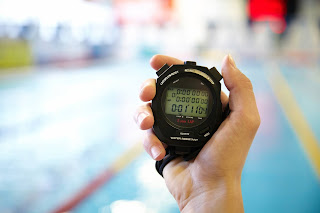
One of the surprising differences I have noticed about kids’ activities in the US compared to Australia is the higher level of parent involvement that is required (or in some cases, even expected of).   Swimming is not an exception to that.   At least within most of the swim clubs in Texas that I have seen, there seems to be a certain requirement of volunteer hours that each family needs to do for the club.   Volunteering can be a great way to ensure your kids can continue to do the sport that they like, and it can also be a great way for parents to get to know other parents in the swim club. One of the most common “duty” that a swim parent may have to do is to work as a “timer” during the swim meet.   If there are 8 lanes in a pool, you will need at least 8 timers.   I say “at least”, because in most meets, you normally require two timers per lane. If your swim club is hosting a meet, they will probably be required to fill the timer slots with parents from ...

What are Sectionals? Futures?

Image
If your child happens to develop into a strong & fast swimmer, there is a good chance he/she will be competing at a "bigger stage".  So what are some of these "bigger stage" competitions when it comes to swim meets?   The below "pyramid" is a good visual aid to show a simplistic view of the different levels of swim meets within the US. Image source:  https://reachforthewall.org/2016/04/14/what-are-junior-nationals-and-futures/ The term "Junior Olympics" (JO)** seems to be more of a term that is used in the US West-coast, as I have never encountered that term here in Texas.  The LSC that my kids belong to, Gulf Swimming, hosts the Gulf "Age Group Championships" twice a year (one for Short Course and another for Long Course).  In order to qualify, the swimmer needs to meet the Gulf Age Group Champs Time Standards.  As the name "Age Group" Champs suggests, it is for swimmers who are 14 years or younger. Although not listed in...

Swim Meets (6): Lane assignments

Image
In most of the Timed Final Meet s or during the Preliminaries where there are multiple heats for an event, the usual order is fastest to slowest heats (i.e. swimmers in Heat 1 are faster than those in Heat 5).  Each swimmer is seeded according to their previous best time.  If it's an event that the swimmer has never previously acquired a swim time, then the swimmer has a " NT " (No Time) and is usually grouped together in the latter heats with other swimmers who also have a NT. But how do the swimmers get assigned in their lanes for their respective heats? General rule of thumb:  the fastest swimmers are positioned in the middle lanes. Using the information available from 2020 USA Swimming Rulebook   (102.5.3, page 28), I created the below graphical table.  I highlighted two rows in yellow as the 8-lane and 10-lane formats are the most common ones you will encounter (the 8-lane format is most common for the US  SCY ).  <Lane assignments> So ...

Swim Meets (5): Swim-offs

Image
I have previously covered various elements of a Prelims/Finals meet in my earlier posts.  One final term I would like to introduce about a Prelims/Finals meet is the " Swim-off ".   A swim-off is required to break a tie for certain swimmers who have finished the Prelims of an event with the same swim time for a certain seeding position. Using an example of a SCY Prelims/Finals meet where the top 16 qualify for the A/B Finals, a swim-off would be required in the following scenarios: a) After Prelims, two swimmers finished with the same swim time for the 8th position.  A swim-off is required to seed the faster swimmer as 8th (& hence qualifying for the A-Final) and the other as 9th (to be assigned to the B-Final) b) After Prelims, two swimmers finished with the same time for the 16th position.   A swim-off is required to seed the faster swimmer as 16th (& hence qualifying for the B-Final) and the other as the first Alternate . c) After Prelims, two s...

Swim Meets (4): Alternates & Scratching

Image
There are two other terms you would need to know for a Prelims/Finals meet :  Alternates and Scratching . If your swimmer qualifies for the Finals, the meet announcer generally makes an announcement to call out the names of the swimmers who have qualified and the two " ALTERNATES ".  The meet organizers would also print out the event results and they will be posted on a designated wall within the venue.  Here is the important part:  if for whatever reason your swimmer cannot compete in the finals, he/she  MUST  withdraw (commonly called " SCRATCH ") from the finals  within 30 minutes of the announcement .  Please make sure your swimmer ALWAYS consult with their coach before deciding to scratch from the finals. If you do not scratch and your swimmer does not show up in the finals, your  swimmer will be suspended from the meet  (i.e. unable to compete for any other events in the meet) and also be fined ($50 seems to be the most common...

Swim Meets (3): Prelims/Finals Meet

Image
I have already covered some aspects of a swim meet in my earlier post  where I briefly mentioned the Prelims/Finals meet format, but I thought I would touch upon this a little bit more in detail. USA Swimming's definition of a Preliminary heat (or Preliminaries): " competition in which a number of heats are swum to qualify the fastest swimmers for the Finals ". (USA Swimming 2020 Rulebook , page 17) The most common Finals format I've seen for a  SCY meet would be the A/B Finals format, where the top 16 swimmers from the Prelims qualify (A-Final: 1st-8th,  B-Final: 9th-16th). In a LCM Prelims/Finals meet, you may also see the Top 20 qualifying for A/B Finals as some LCM pools have up to 10 lanes. Normally the B-Final (also called a Consolation Final ) is swum first, followed by the A-Final (also called a Championship Final ).  It is actually pretty cool when you first see your kid qualify for an A-Final, as the meet announcer announces each swimmers individually a...