Posts

Swim Meets (4): Alternates & Scratching

Image
There are two other terms you would need to know for a Prelims/Finals meet :  Alternates and Scratching . If your swimmer qualifies for the Finals, the meet announcer generally makes an announcement to call out the names of the swimmers who have qualified and the two " ALTERNATES ".  The meet organizers would also print out the event results and they will be posted on a designated wall within the venue.  Here is the important part:  if for whatever reason your swimmer cannot compete in the finals, he/she  MUST  withdraw (commonly called " SCRATCH ") from the finals  within 30 minutes of the announcement .  Please make sure your swimmer ALWAYS consult with their coach before deciding to scratch from the finals. If you do not scratch and your swimmer does not show up in the finals, your  swimmer will be suspended from the meet  (i.e. unable to compete for any other events in the meet) and also be fined ($50 seems to be the most common...

Swim Meets (3): Prelims/Finals Meet

Image
I have already covered some aspects of a swim meet in my earlier post  where I briefly mentioned the Prelims/Finals meet format, but I thought I would touch upon this a little bit more in detail. USA Swimming's definition of a Preliminary heat (or Preliminaries): " competition in which a number of heats are swum to qualify the fastest swimmers for the Finals ". (USA Swimming 2020 Rulebook , page 17) The most common Finals format I've seen for a  SCY meet would be the A/B Finals format, where the top 16 swimmers from the Prelims qualify (A-Final: 1st-8th,  B-Final: 9th-16th). In a LCM Prelims/Finals meet, you may also see the Top 20 qualifying for A/B Finals as some LCM pools have up to 10 lanes. Normally the B-Final (also called a Consolation Final ) is swum first, followed by the A-Final (also called a Championship Final ).  It is actually pretty cool when you first see your kid qualify for an A-Final, as the meet announcer announces each swimmers individually a...

Swim Meets (2): Fly-over starts? Chase starts?

Image
Before a swim meet, I would highly recommend that you read the Meet announcement document in advance so you can understand some of the basic logistics of how it will be run.  It's not a bad idea to go through it with your swimmer as well so they too are aware of it, instead of trying to figure it out on the day of the swim meet.  The coaching staff of your swim club may probably send out a memo with some of the key points to note about the meet, but don't always rely on that to be the case.  Assume you will need to figure it out yourself. The first picture below is the Texas A&M Student Recreation Center set-up as a LCM pool.  The one below that is the same venue, but set-up as 2x SCY pools during Short Course season.  Do you see the white strip of barrier in the middle that is separating the pool into 2 separate SCY pools?  That is called a " bulkhead " or sometimes called the "turn-end" and this enables the conversion of a LCM pool into 2x SCY pools. ...

Swim Meets (1): Basic info

Image
I have covered some basic things you need to prepare for your first swim meet in my earlier post .   But here are some additional details of a typical swim meet for your reference. 1. Swim meets are usually held from Friday (late) afternoon to Sunday afternoon.  Friday sessions are usually short, as they generally only have a handful of events (around 4 or less events) and they are usually the longer distance events (e.g. 500 Free, 400 IM).  So if you have a young swimmer, you probably would not attend the Friday session. 2. Swim meets are usually divided into a "session" . For example: a) Friday = Day 1, Session 1 (usually the longer distance events for all age groups) b) Saturday = Day 2, Session 2 (10 & Under) / Day 2, Session 3 (11 & Over) c) Sunday = Day 3, Session 4 (10 & Under) / Day 3, Session 5 (11 & Over) Generally speaking, there is an "AM" morning session and a "PM" afternoon session during the weekends.  The meet announcemen...

Preparing for your first swim meet

Image
When your child joins a USA Swimming Club and is placed in a team, expect to attend a "swim meet", which is usually once a month and each swim meet usually last 2-3 days.  It is basically an event where your local swim club and other swim clubs from the same LSC (still not sure what a LSC is? Check my earlier post here ) "meet" and have their swimmers race against each other in various events.  It also provides an opportunity for the swimmers to put into practice what they have learned during practice in a race format and to obtain official swim times for their events. When I was growing up in Australia, some of the sports-related events were referred to as "carnivals" (e.g. athletic carnival, swimming carnival).  Personally, I think the word "carnival" has a better (more friendly) ring to it and maybe we should look at adopting it in the US as well, especially for swim meets for the younger age group kids 😊 My eldest son was 9 years old when...

What is a B Time?

Image
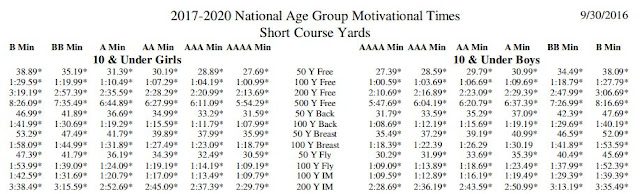
After the completion of my son's first Short Course season, the Long Course season started and as a result, our first Long Course swim meet (if you missed my earlier post about what Short Course & Long Course season means, click here ). In the meet announcement, it said that in order to qualify for the Long Course swim meet, the swimmer needed to have "3x B Times".  I remember thinking to myself "What is a B Time?"  I had no idea what they were. 😅 USA Swimming has various Time Standards and the most basic one you should note is their "Motivational Times" for different age groups.  As of writing this post, the current one is the 2017-2020 Age Group Motivational Times, so it has been around for a few years. You could probably find various Time Standards from your local swim club's website &/or from your LSC (Local Swimming Committee) website (my blog post about how USA Swimming is structured into Zones & LSCs can be seen here ). But it i...

What events are there in swimming?

Image
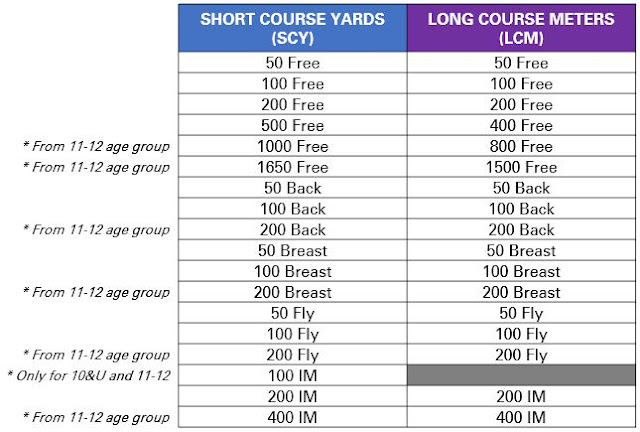
Now that you know what is the difference between Short Course Yards (SCY) vs Long Course Meters (LCM) based on my previous blog post , let's have a look at what individual events are available. Free = Freestyle Back = Backstroke Breast = Breaststroke Fly = Butterfly IM = Individual Medley Swimmer does all of the 4 strokes, in the order of Fly → Back → Breast → Free. 100 IM is only available for the younger age groups (10 & Under and 11-12 years) and for obvious reasons, it is only available in the SCY format (LCM pools are 50 meters in length, so the minimum distance for an IM would be 200-meters). If you would like to know the finer details of what is a "legal" stroke, you could refer to USA Swimming's rulebook (this is the same rulebook that the Swim Officials refer to). The 2020 rulebook can be seen here  - pages 19-23 shows what is a legal start, stroke, turn & finish for each of the events.  Although I have not listed it above (as it's not offi...